Iranian Photographer Says He Was Forced to Fight for Russia in Ukraine
 Hussain Hazbavi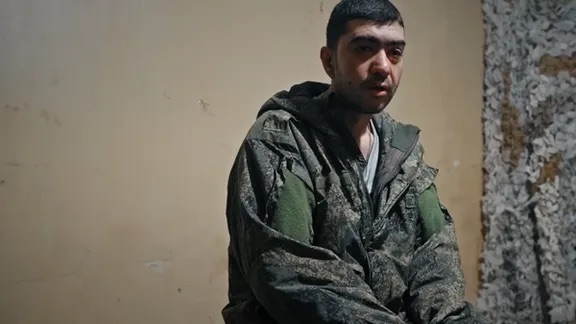
An Iranian photographer who traveled to Russia in search of work says he was coerced into joining the Russian army and sent to fight in Ukraine, according to a report by pro-Kyiv outlet UNITED24 Media.
Arash Darbandi, a 34-year-old photographer from Ahvaz in southwestern Iran, told the Ukrainian media outlet that he entered Russia on a tourist visa and supported himself in St. Petersburg by taking street photographs.
“I photographed people wearing colorful clothes. If they liked the picture, they paid me 1,000 rubles,” Darbandi said, adding that photography had become his main source of income despite being trained as a petroleum engineer.
Darbandi said he was aware that Russia was at war with Ukraine but initially felt removed from the conflict. That changed, he said, after an encounter with police led to his arrest.
According to his account, Darbandi was detained following an altercation with a police officer and transferred to a military facility on Ligovsky Prospekt in St. Petersburg. There, authorities allegedly gave him a choice between imprisonment or being sent to the front line.
“They told me I could either go to prison for three to five years or go to the war for one year,” he said. When he objected and argued that deportation should be the maximum penalty for a foreign national, Darbandi said officers responded: “This is Russia, and you must go to war.”
Iran has emerged as one of Russia’s key military partners since Moscow launched its full-scale invasion of Ukraine in February 2022. Tehran has been accused by Ukraine and Western governments of supplying Russia with hundreds of Shahed-series attack drones, which have been widely used against Ukrainian cities and infrastructure. Iranian officials have repeatedly denied or downplayed the allegations.
Iranian Photographer Describes Coercion, Injury, and Capture After Being Sent to Ukraine
Arash Darbandi said he was held in military barracks for several months before being transferred to a training center near Belgorod, close to the Ukrainian border. Fearing imminent deployment to the front line, he said he deliberately injured himself in an attempt to avoid combat, breaking his arm.
Despite his injury, Darbandi said he was not exempted from military service, even though Russian law allows for medical disqualification. “I had never even held a knife,” he said, stressing that he had no military background or training.
He described the training as brief and coercive, saying recruits were treated as disposable. “They didn’t treat us as humans. They only saw us as expendable and wanted to send us to the front so that Russians could live safely,” he said.
According to Darbandi, foreign nationals including Iranians, Africans, Arabs, Kenyans, and Colombians were separated from Russian soldiers and denied basic rights. “Foreigners have no rights at all. At any moment, they can take whatever you have,” he said.
Darbandi said he was later wounded in a Ukrainian drone strike and captured after being left without medical assistance for several days. He said he now feels deep remorse over his forced involvement in the war and urged others not to cooperate with governments he accused of exploiting vulnerable people.
“Never help countries like Russia and Iran, and those that support terrorism. Please stop the war,” he said.
Recruitment Flyers in Tehran
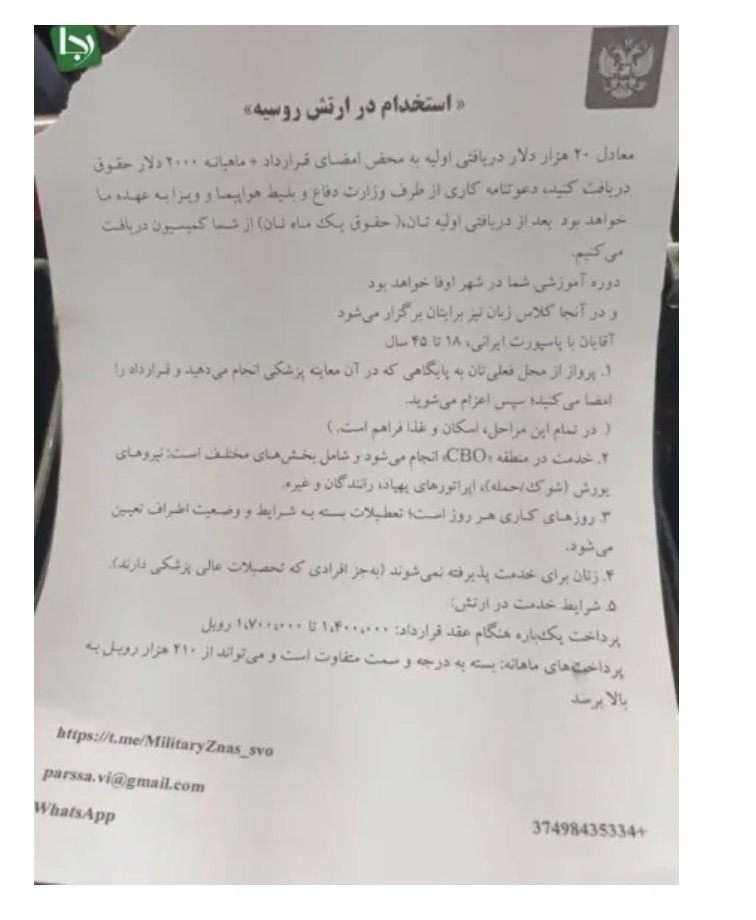
Earlier this month, flyers circulated near the Russian Embassy in Tehran targeting men aged 18 to 45, offering financial incentives to join the Russian army. The leaflets promised signing bonuses of between $15,000 and $18,000, monthly salaries ranging from $2,500 to $2,800, as well as free housing, medical care, and military uniforms.
Tehran-based outlet Rouydad24 reported that the flyers directed interested individuals to a Telegram channel publishing recruitment messages in Persian, Russian, Arabic, and English, describing the campaign as a “state-supported initiative.”
The Iranian report compared the flyers to similar recruitment efforts reported in India, Nepal, Sri Lanka, and several African countries. Foreign media have described these campaigns as part of Moscow’s broader drive to recruit foreign fighters amid heavy battlefield losses in Ukraine.